← Back To List/Index
If you sing/use this song, please contact the composer and say thank you to Mark A. Martin!
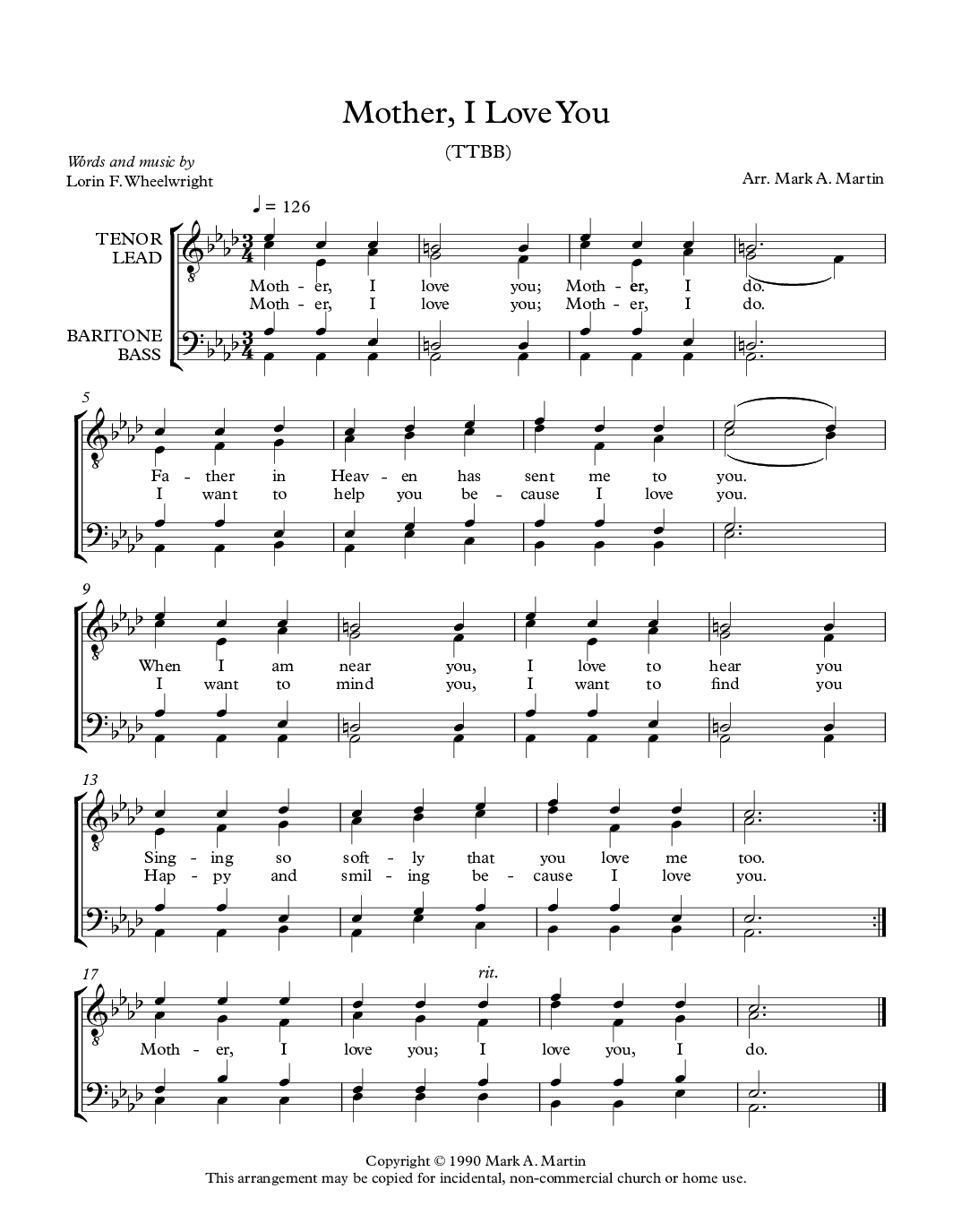
Voicing/Instrumentation: TTBB
We also have other 4 arrangements of "Mother, I Love You".
See more from Mark A. Martin.
No user ratings for this song yet. Leave yours by clicking the button above!
More about Mark A. Martin:
Mark Martin minored in music while earning degrees in statistics at Brigham Young University. He played in the percussion ensemble throughout college, and also performed with BYU's Panoramic Steel. With his love of barbershop harmony, Mark formed a quartet with college friends. They could be found singing informally on and off campus, specializing in Primary songs which Mark arranged in the barbershop style. On occasion, Mark arranges sacred music without the ubiquitous barbershop 7th chords.
Downloads:
If you sing/use this song, please contact the composer and say thank you to Mark A. Martin!
Voicing/Instrumentation: TTBB
We also have other 4 arrangements of "Mother, I Love You".
See more from Mark A. Martin.
Related song categories are:
Children's Songs
Love
Motherhood/Mother's Day/Sisterhood
A Cappella/Optional A Capella
Children's Songs
Love
Motherhood/Mother's Day/Sisterhood
A Cappella/Optional A Capella
No user ratings for this song yet. Leave yours by clicking the button above!
More about Mark A. Martin:
Mark Martin minored in music while earning degrees in statistics at Brigham Young University. He played in the percussion ensemble throughout college, and also performed with BYU's Panoramic Steel. With his love of barbershop harmony, Mark formed a quartet with college friends. They could be found singing informally on and off campus, specializing in Primary songs which Mark arranged in the barbershop style. On occasion, Mark arranges sacred music without the ubiquitous barbershop 7th chords.
Song background:
You can also
bookmark/save this song arrangement to your personal sacredsheetmusic bookmark save list.
Written in men's 4-part harmony.
Balance for barbershop style: Tenor 2 ("Lead") has the melody and should be predominant, with softer Tenor 1 ("Tenor") above the Lead. Bass 1 ("Baritone") is sung softer when a note is above the Lead voice, and stronger when below. Bass 2 ("Bass") is always strong.
The mp3 recording has all parts at equal volume, so be sure instead to harmonize as described above.
This song has been viewed 257 times on this site.
This song's pdf has been viewed/downloaded 77 times.

Report a problem with this song.
